
Which Tracking Technologies Are Best for Hybrid (Indoor + Outdoor) Environments?
Tracking assets in real time is no longer optional — it’s essential. But most businesses operate across both indoor and outdoor environments, and no single technology performs perfectly everywhere. To help clarify the options, here’s a Q&A covering the pros, cons, and combinations of key tracking technologies, with insights from Ubisense’s Comprehensive Guide to Asset Tracking Technologies.
Q1. Why is hybrid (indoor + outdoor) tracking such a challenge?
Indoor spaces like factories, hangars, and warehouses present obstacles such as walls, machinery, and interference that degrade many wireless signals. Outdoors, conditions are different: open spaces allow GPS to work well, but signal can fail under cover (e.g. inside vehicles, near buildings, under roofs).
The challenge is creating seamless visibility — so an asset tracked indoors remains visible outdoors without gaps or accuracy losses.
Q2. Which tracking technologies are most relevant?
From Ubisense’s guide, the leading options include:
-
Ultra-Wideband (UWB): Extremely accurate indoors, with centimetre-level precision. Handles reflections and multipath well.
-
Bluetooth Low Energy (BLE): Cost-effective, easy to deploy, less accurate but fine for coarse location indoors.
-
Wi-Fi / RFID: Leverage existing infrastructure, lower accuracy, useful for broad coverage.
-
GPS: Standard outdoor location, accurate to a few metres but unreliable indoors.
-
RTK-GPS (Real-Time Kinematic GPS): Enhances GPS with correction signals for sub-metre or even centimetre accuracy outdoors.
-
Dual-mode / hybrid devices: Combine UWB with GPS or RTK-GPS to ensure smooth handovers between environments.
Q3. What are the main trade-offs when combining indoor and outdoor technologies?
-
Accuracy: Indoors, UWB excels. Outdoors, RTK-GPS provides high precision where available; standard GPS is less accurate.
-
Coverage & Infrastructure: Indoor systems need anchors and infrastructure; outdoor systems require RTK base stations or correction services.
-
Power Consumption: Dual-mode tags (UWB + RTK-GPS) consume more energy; battery life planning is essential.
-
Cost: UWB offers precision but needs more anchors; GPS is cheaper to deploy outdoors. Combining them increases upfront costs but reduces hidden costs from lost assets or inefficiency.
-
Reliability: Seamless handover between techs is critical. Without an integrated platform, gaps in coverage occur.
Q4. How does RTK-GPS improve outdoor tracking?
Standard GPS typically provides accuracy within a few metres, which may be sufficient to locate a truck somewhere in a yard, but not precise enough to know which bay it is parked in or exactly where a tool was left.
RTK-GPS (Real-Time Kinematic GPS) dramatically improves on this by using correction signals from a local RTK base station or a network service. With these corrections, outdoor positioning can achieve single-digit centimetre accuracy — Ubisense tags can reach as tight as 3–5 cm in two dimensions.
This level of precision makes a real difference in industries where every location detail matters:
-
Transit yards and depots: Pinpointing exact vehicle bays for dispatch or maintenance.
-
Construction and industrial sites: Tracking heavy equipment with accuracy down to individual storage spots.
-
Aerospace and defence facilities: Ensuring high-value assets are located and accounted for with near-perfect precision.
When paired with UWB indoors, RTK-GPS enables organisations to maintain continuous, high-accuracy visibility across both environments, eliminating gaps at the boundary between factory floor and open yard.
Q5. What hybrid approaches work best in practice?
-
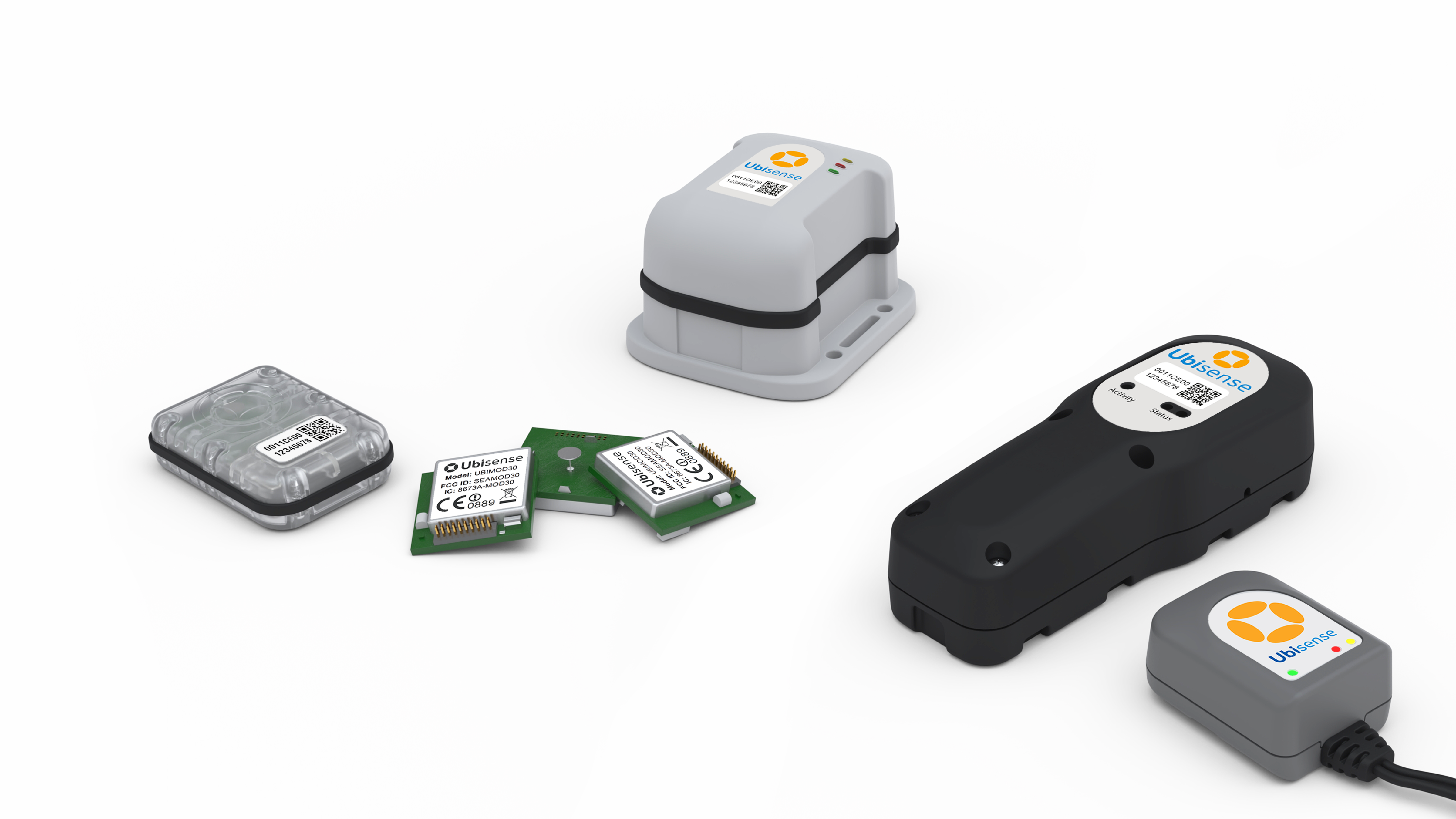
UWB + RTK-GPS dual-mode tags: Provide centimetre-level precision both indoors and outdoors. Ubisense offers dual-mode tags specifically for this.
-
BLE or Wi-Fi + GPS: Lower-cost option where coarse outdoor accuracy is acceptable, and precision indoors isn’t critical.
-
Platform-integrated solutions: Using a platform like SmartSpace ensures data from different technologies is harmonised, so users see one seamless picture.
Q6. Which industries benefit most from hybrid solutions?
-
Automotive manufacturing: Tools and vehicles move between indoor assembly lines and outdoor storage yards.
-
Aerospace MRO: Parts and tools shift from hangars to open aprons, requiring continuous traceability.
-
Transit operations: Buses, trains, and service vehicles cross between depots, yards, and workshops.
-
Pharma & healthcare: Equipment and supplies often move between buildings, or from indoor storage to outdoor loading areas.
In all cases, hybrid tracking reduces search times, prevents losses, and ensures compliance with process or safety requirements.
Q7. What should businesses ask before choosing a system?
-
How much accuracy is required indoors vs outdoors?
-
Do assets move frequently between environments?
-
How many tags and how much infrastructure will be needed?
-
What’s the expected battery life and maintenance burden?
-
How will data from multiple technologies be unified into one platform?
-
What ROI will justify the investment?
Q8. What’s the bottom line?
There’s no one-size-fits-all. But certain patterns stand out:
-
For high-value, precision-critical assets: UWB indoors + RTK-GPS outdoors is the gold standard.
-
For lower-value, coarse tracking needs: BLE/Wi-Fi indoors + GPS outdoors may be sufficient.
-
For organisations demanding continuity: A platform like SmartSpace ensures a seamless experience, regardless of which technologies are combined.