
How RTLS Improves Automotive Manufacturing: Six Key Applications
Automotive manufacturing is one of the most complex production environments in the world. Hundreds of vehicles per day, thousands of variants, thousands of parts — all needing to come together at precisely the right moment on a moving line.
Even small inefficiencies compound fast. And that’s exactly where RTLS delivers.
Ten of the top fifteen global automotive OEMs rely on Ubisense to run their plants. Here’s why.
1. Assembly Line Control and Process Sequencing
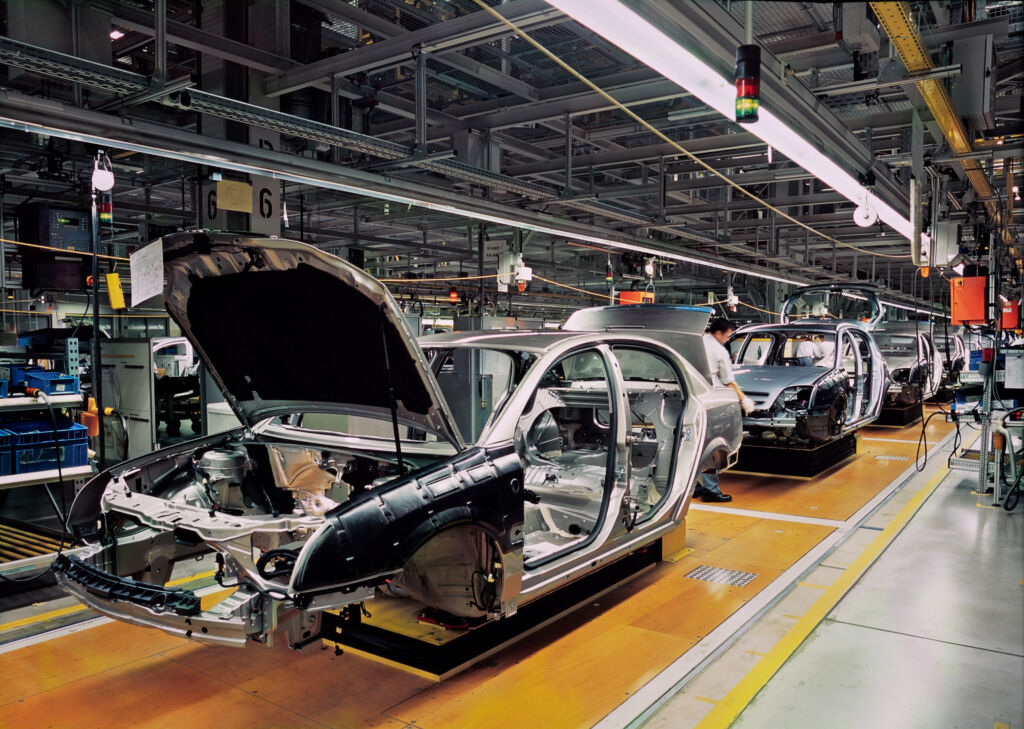
Every vehicle on the line is different. Different models, specs, options — all requiring different tools, torques, and process steps at every station.
RTLS tracks the precise location of every vehicle in real time. As it enters a station, the system:
- Identifies the vehicle automatically — no manual scanning
- Triggers the correct work instructions for that variant
- Configures tool settings for that specific build
- Flags any process deviations immediately
For safety-critical fastenings, this isn’t optional. A quality escape discovered in the field costs far more than the technology that prevents it.
2. Tool Tracking and Control
A torque tool in the wrong place — or used out of sequence — can create a quality deviation that’s invisible until it becomes a warranty claim.
RTLS-based tool tracking gives teams instant visibility of every tool across the facility:
- Find any tool instantly via a live map
- Automated check-in/check-out — no manual logging
- Calibration monitoring — alerts before tools go overdue
- Zone-based control — tools can be prevented from operating unless in the correct zone, over the correct vehicle
That last capability — using location as a control signal, not just a data point — is one of the most powerful forms of error-proofing available in assembly today. See how SmartSpace handles tool control in assembly →
3. End-of-Line Visibility and Rework Management
End-of-line is where quality issues surface — and where fixing them is most expensive. Without real-time visibility, managing this area is purely reactive.
RTLS gives supervisors a live view of every vehicle in the end-of-line area:
- Where it is and how long it’s been there
- What stage of inspection or rework it’s at
- Whether it’s on track for its dispatch window
- Automated alerts when dwell times exceed target
The result: faster intervention, fewer vehicles missing dispatch, and better throughput without adding headcount.
4. Line-Side Logistics and Parts Replenishment
A production line stops when it runs out of parts. Traditional replenishment — kanban cards, manual calls, fixed schedules — is too slow to respond to real-time changes in production pace.
RTLS provides live visibility of parts and kit status along the line:
- Alerts trigger before shortages occur, based on actual consumption
- Replenishment is driven by what’s happening on the floor, not what was planned
- Less buffer stock, fewer line stoppages, more responsive supply flow
5. Yard Management and Vehicle Dispatch
The line is only part of the picture. Finished vehicles still need to be staged, inspected, allocated, and dispatched — across outdoor yards covering tens of thousands of square metres.
Without RTLS, finding a specific vehicle in a large yard means physical searches, wasted time, and missed carrier windows. With it:
- Every vehicle is visible on a live map — indoors and outdoors
- Automatic staging guides vehicles to the right zone for PDI, wash, or carrier loading
- Dispatch scheduling integration ensures the right vehicles are ready when carriers arrive
Research from the University of Twente consistently shows UWB-based systems outperform alternatives in complex industrial environments — which describes most automotive yards precisely.
6. Quality Traceability and Compliance
IATF 16949, safety-critical component traceability, audit readiness — the compliance burden on automotive manufacturers is only increasing.
Traditional traceability relies on manual records and barcode scans at fixed points, reconstructed after the fact. RTLS builds the digital record in real time:
- Which tool was used
- On which vehicle
- At which station
- At what time, by which operator
This continuous, automated audit trail means faster audit responses, fewer documentation gaps, and genuine process compliance — not paper-based compliance theatre.
The Bottom Line
Across all six applications, the value is the same: when you know precisely where everything is in real time, you make better decisions, prevent errors before they happen, and respond faster when they do.
The difference between using RTLS as a basic tracking tool and using it as a true operational intelligence layer shows up in quality metrics, throughput, and cost of production.
Trusted by 10 of the top 15 global automotive OEMs across 40+ countries.
Talk to our team about what this could look like in your plant →