
Behind the Buses: The Hidden Operational Challenges of Transit Depots and How Ubisense Solves Them
Bus and coach depots remain some of the most operationally demanding environments in transit: large, mixed fleets, tight turnaround windows, sprawling and often part-covered sites, and 24/7 coordination requirements that leave little room for error. Get it wrong, and the knock-on effects surface immediately as late departures, missed connections, and rising operating costs.
Below are six of the operational challenges depot and yard managers deal with day to day, and how Ubisense’s SmartSpace platform addresses each one.
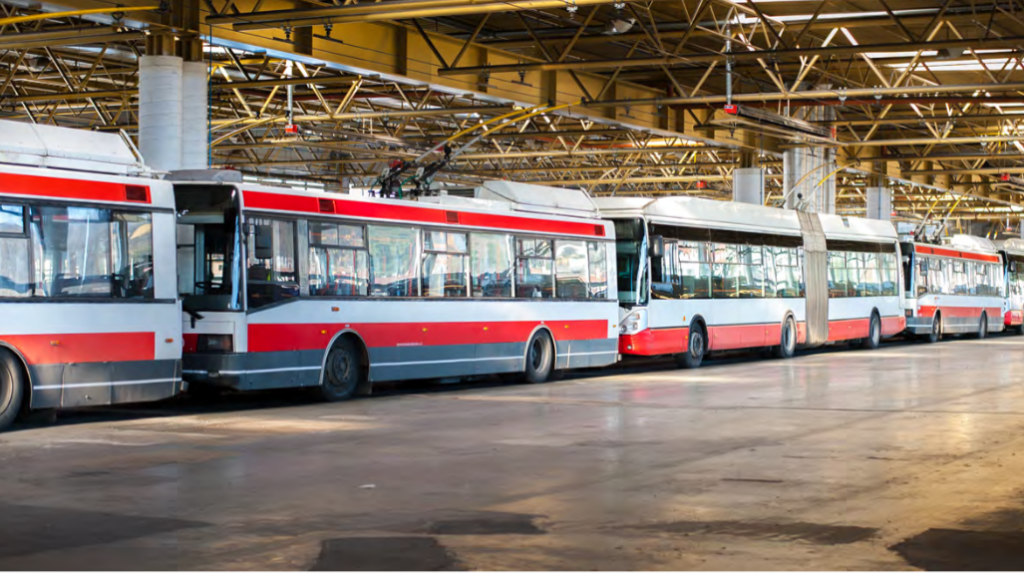
Pain Point 1: No reliable way to locate vehicles on site
Many depots still rely on manual processes: “clipboard and pen” methods of managing the yard that were never designed for fleets of hundreds of vehicles moving in and out around the clock. GPS, the obvious answer, often doesn’t work well here: depots are frequently indoor, underground, or surrounded by steel structures that block satellite signal entirely.
This is a recurring theme in depot operator feedback. Transports Publics Fribourgeois (TPF), which runs a fleet of over 250 vehicles in Switzerland, needed a way to locate buses in a depot without GPS signal, to a precision under a metre, something conventional tracking simply couldn’t deliver.
How Ubisense addresses it: Ubisense uses Ultra-Wideband (UWB) tags, small transmitters attached to each vehicle, that communicate with a network of sensors installed around the depot. The real-time location data is fed straight into the depot management interface, giving dispatchers continuous, accurate visibility regardless of whether a vehicle is indoors, underground, or in a steel-framed shed. For outdoor areas such as parking zones and coach yards, Ubisense’s Dimension4™ RTK-Tag adds signal-corrected RTK-GPS, delivering accuracy down to a few centimetres in the open air. Used together, UWB and RTK-GPS give depot managers seamless, continuous tracking as vehicles move between covered and open areas, something neither technology can achieve alone.
Pain Point 2: Scheduling and dispatch drift
Even a well-planned timetable falls apart if a depot team can’t confirm buses are in the right lane, at the right bay, at the right time. Precise, real-time positioning is what allows dispatch teams to follow the schedule and manage the departure process correctly rather than relying on guesswork or radio calls.
How Ubisense addresses it: With every vehicle continuously tracked, the system can alert staff the moment a bus deviates from its expected position or timing, so problems are caught before they cascade into missed departures. TPF reported 24/7 visibility of buses across the depot, consistently accurate location information keeping vehicles in their correct lanes and parking spaces indoors and outside, and considerable improvements in workflow optimisation within the scheduling application after deployment.
Pain Point 3: Mixed fleets and EV charging bottlenecks
The shift to electric buses has added a genuinely new layer of complexity. Charging vehicles with a limited number of charging points often means complex, last-minute reshuffling of the yard, and calculating the most efficient way to park and move vehicles around a site is difficult even for experienced managers. A mixed fleet of diesel, hybrid, and electric vehicles also makes storage and maintenance planning more complex still.
There’s a safety dimension too: separating EVs and automating charging station usage helps depots manage the (albeit rare) risk of EV battery fires causing chain reactions.
How Ubisense addresses it: Because the system knows the exact location and status of every vehicle, depot managers can plan and prioritise charging schedules so buses are charged efficiently and ready for dispatch, coordinate maintenance for vehicles that need it, and automatically keep EVs appropriately separated during charging. The same real-time visibility applies across a genuinely mixed fleet, so managers aren’t juggling separate systems for diesel and electric vehicles.
Pain Point 4: Maintenance visibility and downtime
Flagging which vehicles need servicing, and making sure they’re actually seen to, is a constant background task in any depot, and one that’s easy to lose track of manually.
How Ubisense addresses it: Vehicles needing maintenance or refuelling can be flagged on a customisable dashboard, with colour-coded symbols and precise locations visible to staff on handheld devices. This keeps everyone working from the same live picture of what needs attention and where it is, helping ensure vehicles are ready on time for dispatch and, per Ubisense’s transit customers, enabling precise tracking of buses requiring maintenance so they’re promptly attended to.
Pain Point 5: Thin staffing, tight margins
Depots aren’t immune to the wider labour pressures facing transit: many operators find it increasingly difficult to staff transport hubs and find enough drivers and maintenance workers to keep things running smoothly. Fewer people means every remaining staff member needs better tools, not more paperwork.
How Ubisense addresses it: By automating tracking, alerts, and reporting that used to require manual checks and radio confirmation, SmartSpace reduces the workload on a leaner team. Entry and exit can also be automated, with only correctly tagged vehicles allowed through barriers, which improves security and reduces the need for a staffed entry point altogether.
Pain Point 6: Fragmented systems across sites
Larger operators rarely run just one depot. Different yards under the same operator often end up running different, non-integrated systems, which leads to service disruption and higher operational costs, a problem that only grows as networks expand or merge.
How Ubisense addresses it: SmartSpace is built to scale across multiple sites and integrate with third-party scheduling and yard management tools rather than replace them outright. In one North American deployment, Ubisense’s tags and sensor network were integrated with an existing scheduling system to regulate 500 buses and service vehicles across three separate yards, giving a single operator one consistent view across all of them. For larger networks, Ubisense Operations 360 extends this further, embedding location intelligence across scheduling, maintenance, and service delivery rather than leaving each function as an isolated system.
The bottom line
Transit depots are asked to do more with less: bigger and more varied fleets, tighter margins, fewer staff, and rising passenger expectations for punctuality. The pain points above rarely make headlines, but they’re exactly where delays, breakdowns, and unnecessary costs actually originate.
Ubisense’s approach, combining UWB for precise indoor and underground tracking with RTK-GPS for outdoor areas, unified in the SmartSpace platform, gives depot managers one continuous, accurate view of every vehicle, wherever it is on site. As one long-standing Ubisense customer put it: the technology is the key to their operational organisation, and they couldn’t run their network without it.
If your depot is still running on radios and spreadsheets, it’s worth asking what a live, accurate view of every vehicle on site could do for your schedule, your maintenance backlog, and your bottom line. Please, get in touch here.